 KecoughtanKecoughtan (variously pronounced "KEE-koh-tan" or "KECK-oh-tan" and also spelled Keequotancke, Kiquotan, Kikotan, etc.) means "great town" in Algonquian according to Barbour. As a large trading community controlling traffic in and out of James River, its numerous inhabitants controlled hunting territory on both sides of the James and made up one of the largest and most prosperous Algonquian villages on the bay.Strachey wrote that Kecoughtan was "the Seat sometymes of a thowsand Indians and 300. Indian howses," suggesting a more permanent occupation than most villages. The Powhatans had conquered it following a long conflict some time around the year 1596 or 1597, after an elderly chief died and the Powhatans killed the remainder of the village's previous leadership, installing Chief Powhatan's son Pochins and other officers over them instead. This may have contributed to the village's total population dropping from as many as one thousand to as few as about seventy-five inhabitants by 1607, with the others perhaps withdrawing either northward into Rappahannock territory or southeastward into Carolina Algonquian territory or both. The Jamestown colonists destroyed Kecoughtan and seized the area for themselves during the First Anglo-Powhatan War, in revenge for the killing of some colonists during the Starving Time. What became Elizabeth City, and today Hampton City, is the oldest English settlement which is still inhabited in North America today. 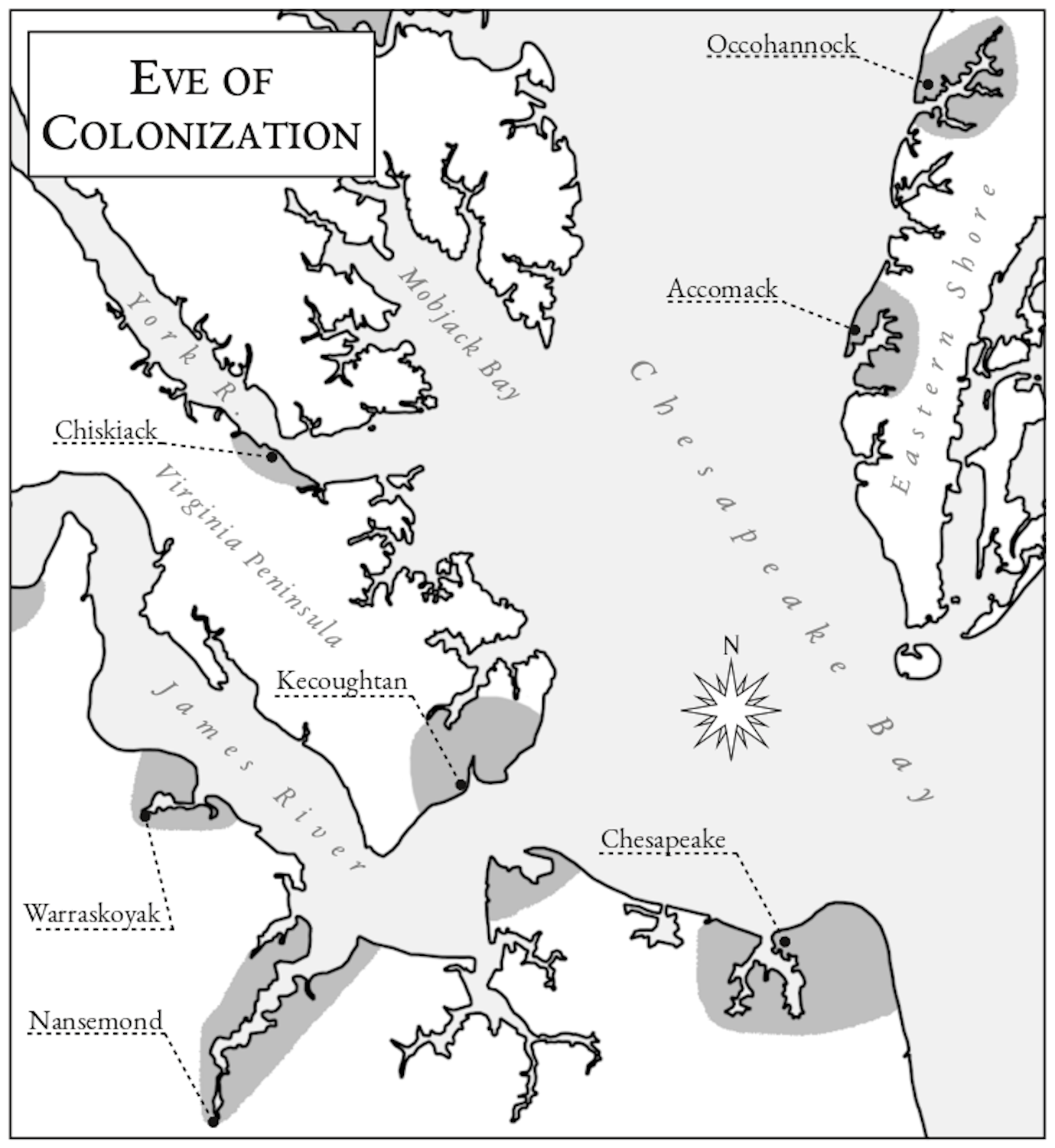 SourcesPhilip L. Barbour, "The Earliest Reconnaissance of the Chesapeake Bay Area: Captain John Smith's Map and Indian Vocabulary," VMHB 79, 3 (Jul. 1971), 288.J. E. Davis, Round about Jamestown; Historical Sketches of the Lower Virginia Peninsula (Hampton, Virginia: Self-published, 1907), 33. April Lee Hatfield, "Spanish Colonization Literature, Powhatan Geographies, and English Perceptions of Tsenacommacah-Virginia," The Journal of Southern History LXIX, 2 (May 2003), 271-272. Joe B. Jones, "Uncovering Traces of Historic Kecoughtan: Archaeology at a 17th-Century Trading Plantation Site in the City of Hampton, Virginia," William & Mary Center for Archaeological Research website, https://www.wm.edu/sites/wmcar/research/pentran/index.php, accessed August 2022. Ben C. McCary, Indians in Seventeenth-Century Virginia (Charlottesville: University Press of Virginia, 1995 [1957]), 4. Helen R. Rountree and Thomas E. Davidson, Eastern Shore Indians of Virginia and Maryland (Charlottesville: University Press of Virginia, 1997), 48-49. Frank G. Speck, Chapters on the Ethnology of the Powhatan Tribes of Virginia, vol. I, no. 5 of Indian Notes and Monographs, F. W. Hodge, ed. (New York: Museum of the American Indian, 1928), 290. |