 Prehistoric Mississippian Frontiers"The villages of the Mississippian culture were much larger, more complex, and more permanent than other Late Woodland villages. The people cleared and farmed hundreds of acres of river floodplain to support village populations that numbered in the thousands.…Tall, distinct, flat-top mounds dominated each of the villages." -- Egloff and Woodward, First People: Early Indians of Virginia 1 In the Cairo Lowlands of the American Bottom in southeastern Missouri, conventionally dated to roughly 700 or 800 AD, some of the largest villages in the heart of Hopewellian territory began to suddenly show signs of dramatic cultural transformations. According to Charles Hudson, this is where Mississippian culture first flowered and reached the pinnacle of its expression. He admits, however, that "it is difficult for archaeologists to reconstruct how the Mississippian way of life spread to other areas." The Hopewellian expansion had previously reached the mouth of the Mississippi River and the Gulf region. As always, the flow of trade had meant the flow of people from Hopewellian communities into foreign territory and vice-versa, and so trade contacts as far south as Mexico had attracted widespread attention from distant peoples with different lifestyles, religions, and systems of tribal governance. In general, the greatest Mississippian complexes seem to have suddenly appeared and developed on top of former Hopewellian complexes, taking over pre-existing populations and trade and perhaps instituting new priesthoods or religious cults to effect their wider (and probably more authoritarian) cultural changes. A genetic study by Jennifer Raff showed "evidence for some degree of gene flow consistent with a model of low levels of migration" across Mississippian frontiers. She noted that since Cahokia had roughly the same population as Venice or Milan during the same time period, "low levels" of outside migration might have still translated into scores or even hundreds of individuals, enough to potentially establish new clans or castes of priests, warriors, or chiefs, for example. Hopewellian societies, as sophisticated as they had become, remained largely unchanged from early pottery times in terms of their semi-nomadic hunting and gathering lifestyles, typically gathering at their villages only for special ceremonies and so on, with mostly children and the elderly populating their largest villages year-round. Whether Hopewellian traders had been obtaining foreign wives, or vice-versa, or whatever the case may have been, new Aztec-adjacent goods, people, and cultural traditions began arriving up the Mississippi. The broad cultural changes introduced alongside these new Meso-American arrivals were "sudden, and characterized by alterations of nearly all aspects of life" from agriculture to warfare. This was not a subtle or trivial transformation, but one that suggested itself even in the earliest surveys. Mississippian people transformed Hopewellian ceremonial earthworks, formerly rounded in shape, into rectangular, flat-topped pyramids of earth with completely different social and religious functions. Timothy Pauketat wrote that the changes were "so abrupt" that they created a "historical disjuncture," which sounds like yet another way of describing a frontier. Despite prehistoric migration models being generally discouraged by late 20th-century archaeological models, Freimuth, Hall, Porter, Voge, Alt, Byers, Pauketat, and Griffin all argued for migration theories in this particular case to explain the obvious and sudden cultural discontinuity. Alt, Byers, and Pauketat wrote that Cahokia's population had likely been "drawn in from surrounding regions," while Griffin insisted that the new aspects of Mississippian culture had "almost certainly" arrived from Mexico.2 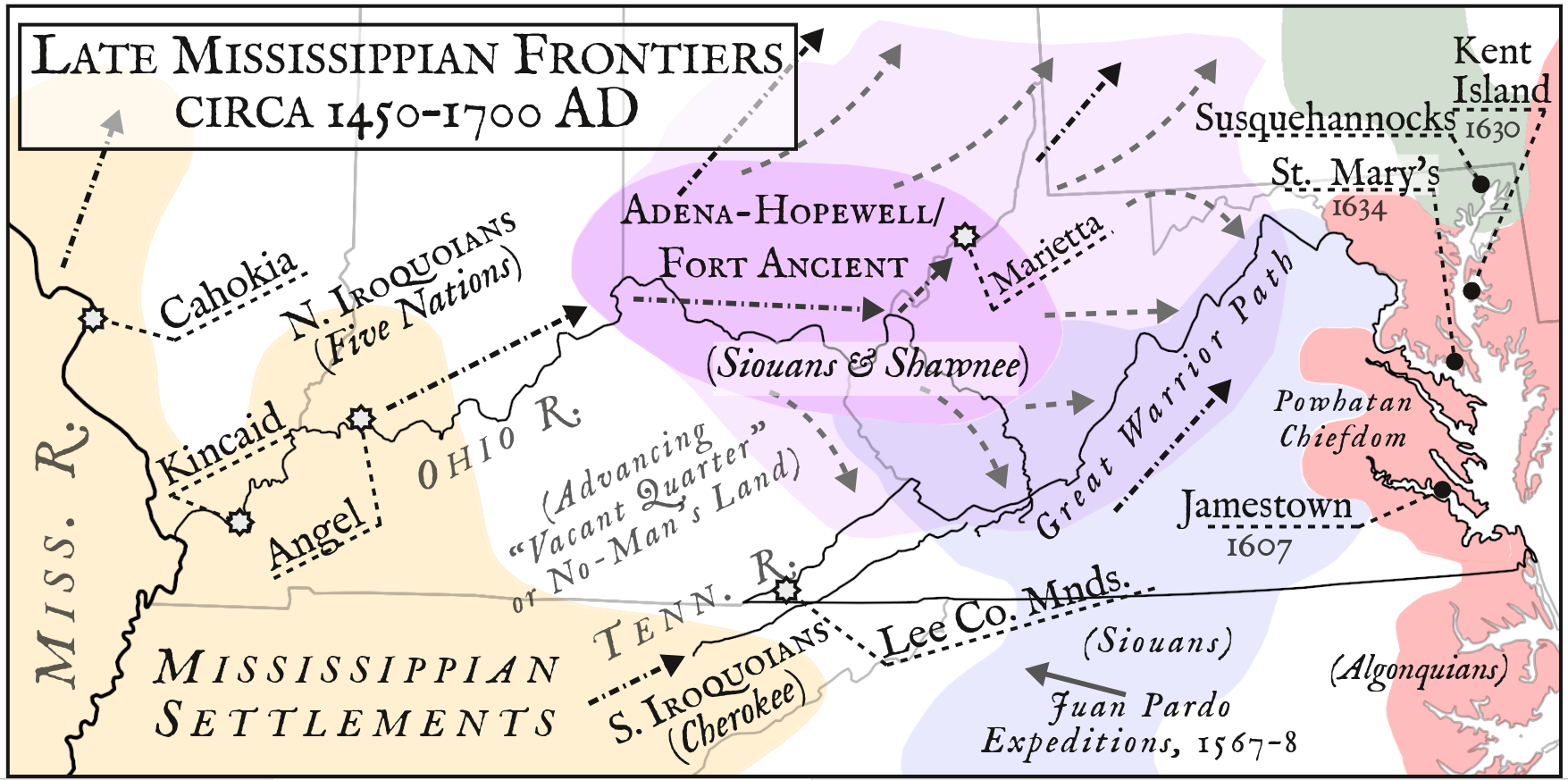 A map representing late prehistoric and early historic frontiers between the Mississippi River and Virginia, roughly between 1450 and 1700. The arrows indicate migratory routes of different cultures along different valleys during these two and a half centuries or so, just as the English were beginning to colonize the lower James River and Chesapeake Bay. From Frontiers of the Lower James River, Part One (2026). The largest Mississippian complexes or chiefdoms centered on large settlements at Cahokia, Moundville, Coosa, Etowah, Natchez, and Quivira were generally along the Mississippi River, its major tributaries, or the gulf coast. The locations of all of these are known with certainty except for the principal village of the Coosa tribe, which remains disputed. These were the largest urban centers or holy capitals of Mississippian territories whence these peculiar new polities exerted their centralizing influences. Tribes living in the more rural, surrounding territories meanwhile remained "more egalitarian" according to Hall (and more likely to refuse orders and rebel) with economies based more directly on hunting and gathering rather than the complex trade networks and arrangements associated with the former Hopewellian and now Mississippian market and ceremonial centers. The arrival of Mississippians was the arrival of a relatively small group as a new leadership class, and though anthropologists avoid using such direct ideas and language, the history of the world is filled with such conquests, which is what the advent of the Mississippian frontiers seems to have represented: conquests. Mississippian towns and cities reached their peaks at slightly different times before collapsing at slightly different times. During their relatively brief and late existence they were always a "patchy distribution of groups with only irregular contact with one another," writes Milner. Mixed communities of different cultures had occupied these parts prior to Mississippian arrivals, and the different regions continued expressing distinct regional traditions and even retained their distinct languages throughout their respective Mississippian phases of occupation. What perhaps unified Mississippian peoples more than anything was the shared religion and culture of their new ruling class, which seems to have reached its greatest expression at Cahokia (to which pilgrimages may have even been made) but in a wider context represented the leading edge or frontier of Aztec-related cultures migrating northward from late prehistoric Mexico. Because of the underlying differences between the different territories they took over, each Mississippian area of activity was its own "regional phenomenon" in the words of Egloff and Woodward, or rather regional phenomena with certain defining traits originating from late prehistoric Mexico. Specifically, the founding bands carrying Mississippian culture conquered or otherwise installed a priestly warrior class on top of earlier Hopewellian, Adena, Copena, and other peoples, such that they immediately converted their old rounded mounds into the new, "flat-top mounds" upon which their great chiefs and priests and their immediate families built their foreboding residences. From here the new rulers instructed and commanded their subjects to cultivate corn on an unprecedented level to now make up as much as half of their diets, simultaneously introducing the intensive cultivation of Aztec kidney beans. The manner in which Mississippian culture reached Hopewellian or other communities and established itself "on top of" previous communities meant that significant cultural variation emerged from settlement to settlement. For example, their iconic mounds did not always serve the same purposes in all locations. Louisiana's Crook Site mound proved to have more than one thousand burials in it, while on the other end of the Mississippian frontier in time and space, the Mississippian mounds at Marietta, Ohio appear to have contained few to no burials. Early French explorers in Louisiana reported Mississippian villages conducting ritual sacrifices upon some of these mounds and then burying the victims inside of the mounds, and that villages sometimes sacrificed wives and servants of powerful chiefs upon their deaths so that they might continue serving the chief in the spirit world. Aside from these truncated pyramid mounds so distinctive of Mississippian societies, their personal residences likewise varied from place to place, sometimes being circular or oval in form and other times being rectangular structures. With the abundance of corn meal which they could easily carry in satchels around their belts (typically carrying bear fat or other grease in another satchel), Mississippian warriors could afford to go on long-distance hunts and raids in large groups of hundreds of braves for months on end without running out of food. The greater abundance of calories also meant that their communities could sustain larger populations in general, so Mississippian phases in prehistory typically came with large populations despite the accumulating casualties from war increasing over the same time. Fortifications around Mississippian villages became correspondingly larger, more robust, and more complex than their Hopewellian predecessors and rivals. Beans were another important source of nutrition which Mississippians brought into the former territory of the Eastern Agricultural Complex, specifically the same varieties of kidney beans grown by the Aztecs in Mexico. Combined with squash (which had already been grown for its seeds by Adena and Hopewell farmers), Mississippian farmers unlocked the "three sisters" technique of growing corn, beans, and squash so that the beans vine up the cornstalks while the broad leaves of the squash vine along and cover the ground to shade out unwanted weeds. This technique became popular even in parts of the continent that Mississippian migrations never fully reached, including the Chesapeake Bay region by around 1000 AD. Jamestown's founders would later find those Algonquians employing the same technique to plant their crops together in heaps of dirt or in the pits of excavated tree stumps.3 Adapted from chapter 4 of Frontiers of the Lower James River by Brian Bray (Greater Barrington, 2026). Notes1. Egloff and Woodward, First People: Early Indians of Virginia (1992), 31.2. Charles Hudson, Juan Pardo Expeditions: Exploration of the Carolinas and Tennessee, 1566-1568 (Washington, D.C.: Smithsonian Institution, 1990), 59; Jennifer Anne Raff, "An Ancient DNA Perspective on the Prehistory of the Lower Illinois Valley," Doctoral Thesis submitted to the Departments of Biology and Anthropology, Indiana State University, 2008, 9-13; Timothy Pauketat, Ancient Cahokia and the Mississippians (New York: Cambridge University Press, 2004), 10; Patrick Livingwood, "Recent Discussions in Late Prehistoric Southern Archaeology," Native South 1, 1 (Jan. 2008), 9-10. 3. Egloff and Woodward, First People: Early Indians of Virginia, 26, 29, 31; Philip L. Barbour, "The Earliest Reconnaissance of the Chesapeake Bay Area: Captain John Smith's Map and Indian Vocabulary," VMHB 80, 1 (Jan. 1972), 32; Livingwood, "Recent Discussions in Late Prehistoric Southern Archaeology," 14; George R. Milner, The Moundbuilders: Ancient Peoples of Eastern North America (London: Thames and Hudson, 2004), 133-136, 151; Robert L. Hall, "The Cahokia Site and Its People," in Hero, Hawk, and Open Hand: American Indian Art of the Ancient Midwest and South, Richard F. Townsend, ed. (New Haven, Connecticut: Yale University Press and Art Institute of Chicago, 2004), 96. |