 Frontiers of the Prehistoric Fort Ancient CultureIn the face of incoming Mississippian migrations from farther downstream in the old Hopewell homelands, the Adena-Hopewell people evidently had enough of a forewarning to relocate entire villages from the bottomlands to the hilltops. Their traders and hunting parties had undoubtedly come into contact with the new neighbors long before Cahokia and then the Angel Chiefdom developed. The Mississippian expansions had occurred almost exclusively in what had been Hopewellian territory, evidently subjugating or eliminating the previous ruling classes of the Ohio Hopewell's distant cousins all the while, then building their pyramidal mounds on top of Hopewell sacred sites. A preponderance of evidence from across the valley (including the very existence of so many hilltop forts) confirms that the Adena-Hopewell did not welcome their cousins' conquerors into their own valleys with open arms, but rather fought them in a costly and drawn-out conflict in which the level of cultural sophistication of both sides ultimately declined and made them more susceptible to European colonization. 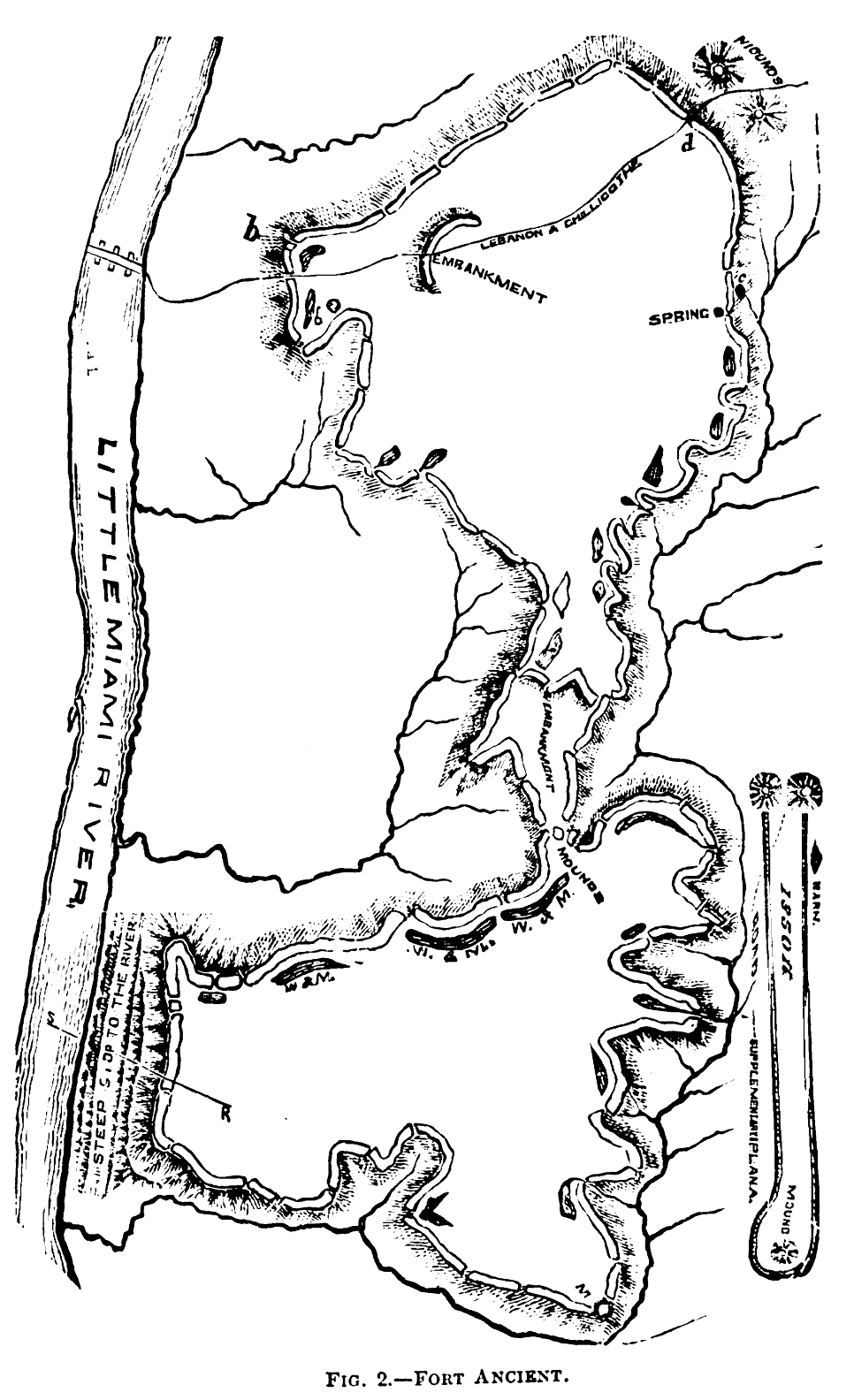 An early survey of the original Fort Ancient Site, which was a hilltop with the remnants of prehistoric fortifications built all around its summit and cliff faces. The complex, culturally-mixed communities of the Adena-Hopewell had long been relatively sophisticated compared to their neighbors, however, and they also seem to have offered far more stubborn resistance over a far longer period of time. Resist or not, waves of Mississippian raiding and assaults continued for as long as about two and a half centuries or so against the Adena-Hopewell people, who now entered their late and defensive "Fort Ancient phase." Between the mid 1500s and the late 1600s most Fort Ancient people abandoned their former valleys into more remote, surrounding regions, although about a generation later, around 1700, a large contingent seems to have returned to their former capital of Chillicothe. The earliest French and English explorers were by then mapping the Ohio Valley, with the French historically identifying the recongregated people by names such as "Chouanon," evidently the same people that the Spanish had previously called the "Savannah" and the English the "Shawanee" or Shawnee. Also recongregating on the Ohio by that time were the Lenape (another tribe seemingly part of the "Hopewellian" component of the Adena-Hopewell) and a number of other tribes in lesser numbers. The earliest accounts from Virginia's western frontiers first refer to the little-known tribes living on the Ohio River as the Mohetans or Tomahitans, during the 1670s when the ancestral tribes along the lower Kanawha had not yet abandoned their lands. After the Hopewellian Crab Orchard people had already fallen to the Mississippian Angel Chiefdom farther downstream, the next stage of the Mississippian invasion seems to have commenced from Angel's eastern frontier and away from the massive societal collapses unfolding behind them at Cahokia and other major centers. Those collapses probably had something to do with early contact with the Spanish by the 1550s and generated waves of refugees up the Ohio River who joined existing frontiersmen in their advance into the Adena-Hopewell heartland of the middle Ohio Valley. The western frontier of that heartland reached downstream to around the Ray Site (the limit of the Angel Chiefdom's effective authority) while its eastern frontier extended upstream to what is now Pittsburgh and the headwaters of the Ohio River around western Pennsylvania and approaching the Great Lakes in upstate New York. Having had more time to prepare than those who had fallen before them, the people of the central Ohio Valley used that extra time to construct their complex of elevated fortifications which were difficult to see from the valleys and used cliffs and other harsh terrain to their advantage. These forts (from which their inhabitants take the name "Fort Ancient") often enclosed mountain springs, garden areas, wooden guard towers, and even featured special rock mounds on high places for building large fires and sending smoke signals to other forts. Fort Ancient people at first built many small fort communities quickly and seemingly relatively undisturbed, large enough for no more than about four hundred people each (and usually significantly fewer). Only after some time did the remaining fort communities congregate together at even larger and more expansive redoubts capable of sustaining populations greater than about four hundred people, and these larger sites show more similarity to classic Adena-Hopewell village traits, including the maintenance of separate cemetery areas and burial practices. Haag notes that only one Ohio Fort Ancient site, the Incinerator Site near Dayton, shows evidence of the kind of astronomical observatory these people had formerly built in the valleys. Otherwise, the design of these forts was clearly more practical than ceremonial, while Moore and Raymer concluded that community leadership and organization devolved to a "situational" and "household" level during these times. Not since Paleoindian or early Archaic times had communities been of such consistently small size, reinforcing that these societies were experiencing a form of collapse. After the construction of many of these forts, Dye notes that it became increasingly deadly for the inhabitants inside to venture outside. "Death was a real possibility beyond the community’s safe zone," he writes. The relatively large number of prehistoric skeletons which appear to have been gnawed by animals and buried some time after death suggest that ambushes outside of the community centers were common, with bodies having to be recovered and returned some time later. Regions becoming more densely-populated caused the "safe zones" between rival groups to shrink and ultimately collapse. It was in and around these forts, sometimes within the very walls of these hill forts, that many western Algonquians and eastern Siouans made their final stands against Proto-Iroquoians just as Europeans also began infiltrating their valleys. Adapted from Frontiers of the Lower James River, Part One: Ice Age to 1606, pages 173-183. Notes1. James E. Fitting, "Regional Cultural Development, 300 B.C. to A.D. 1000," in Northeast, Bruce E. Trigger, ed. (Washington, D.C.: Smithsonian Institution, 1978), 49, 52.2. David Dye, War Paths, Peace Paths, 13; Haag, 106; Milner, 76; Christopher R. Moore and C. Martin Raymer, “A Survey of Fort Ancient Sites in Southeastern Indiana,” Indiana Archaeology 9, 1 (2014), 186-188. |