 Old Copper FrontiersSome of the earliest descendants of the Old Copper communities divided into two major groups: the "Glacial Kame" culture which spread southward into the Ohio Valley, and the "Red Ocher" culture which spread across both sides of Lake Michigan, the westernmost portion of which spread brought them into the upper Mississippi Valley. There the Red Ocher people appear to have been a dominant contributing people to the emerging Hopewell culture, while the Glacial Kame entered the Ohio Valley to fuel the ethnogenetic transformations which created the Adena complex. Thus the Old Copper people began colonizing outside of the Great Lakes, or at least contributing to the early, pre-existing societies their descendants joined. Migrations through and into the Ohio Valley would continue without end, creating more complex patchworks of overlapping and related villages, chiefdoms, and clan networks. Sassaman observed that the Ohio Valley became "a multicultural zone of contested identity" on the fringes of more uniform cultural zones: in other words, a contested frontier. 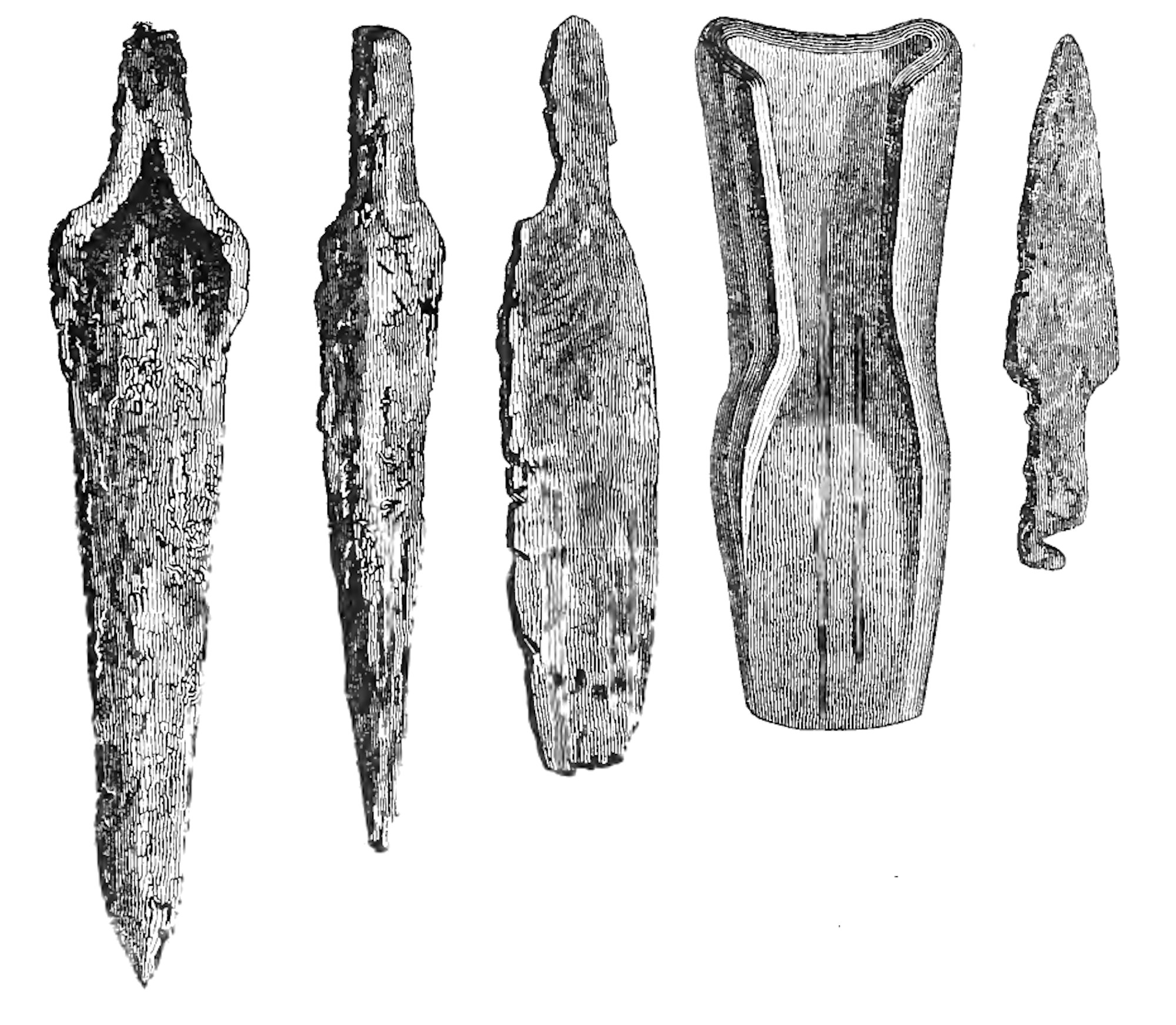 An illustration of Old Copper implements from Squier and Davis. The exchanges and cultural interactions resulting from this growing copper trade across the prehistoric Great Lakes region led to the development of impressive new, monumental societies. These prehistoric chiefdoms seem to have controlled the flow of copper and other trade goods through key chokepoints on the Mississippi (Hopewell communities), Ohio (Adena communities), and St. Lawrence rivers (Meadowood communities), among others. The inheritors of Old Copper culture on the St. Lawrence migrated down the Susquehanna River to Chesapeake Bay around the same time that the earliest Proto-Algonquians regions Virginia from the Ohio Valley, after traveling up the Kanawha, New, and other rivers and crossing the Appalachian Mountains (giving rise to the Lewis Creek Mound Complex). These cultures continuing developing for a time more or less in situ as traders and other travelers passed through their territories, but the Hopewell people seem to have expanded faster and farther than the Adena, for example, whose territory they eventually entered and occupied to create the Adena-Hopewell Complex. 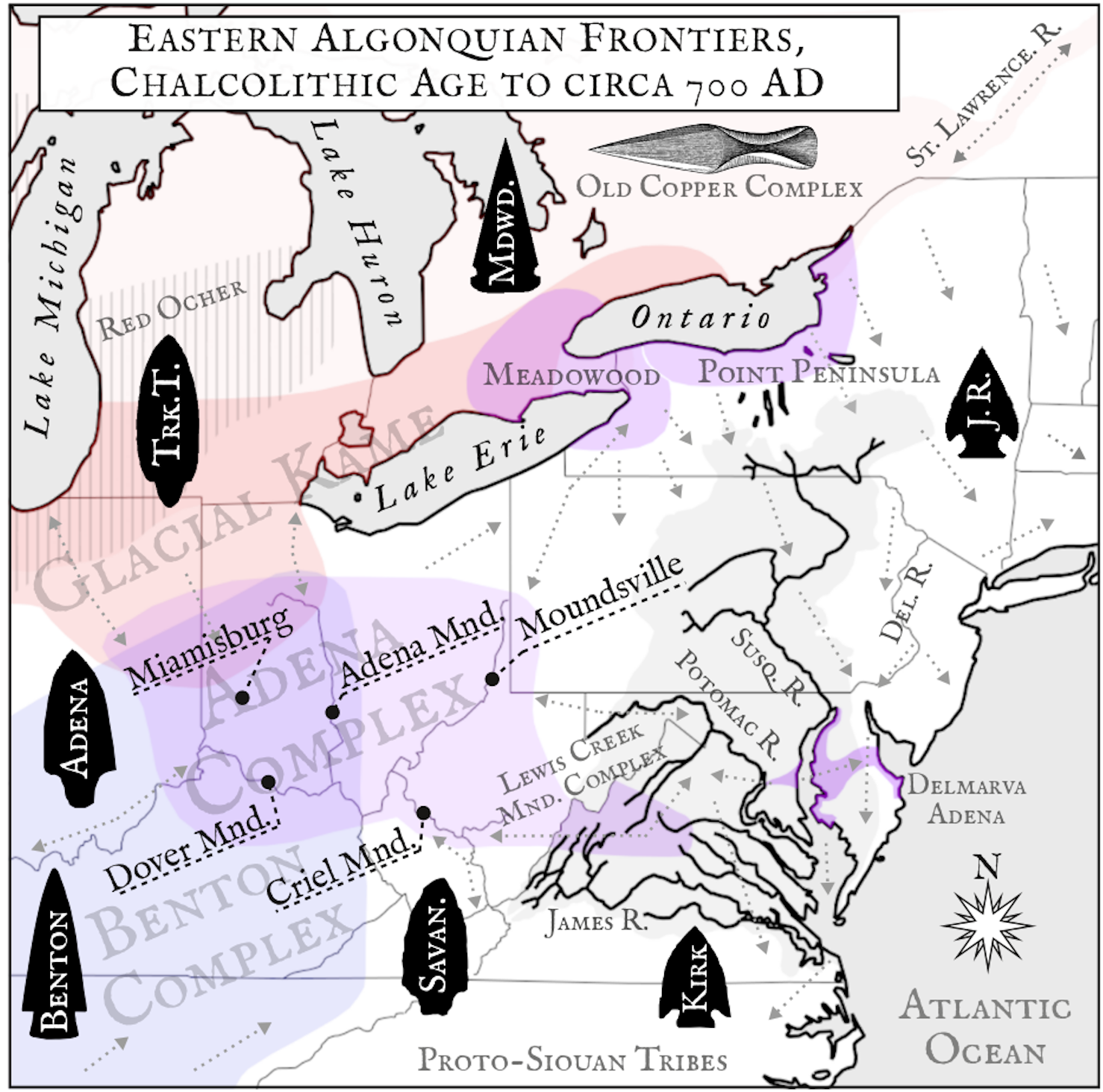 Old Copper diagnostic artifacts appear as far south along the Atlantic Coast as Chesapeake Bay's Delmarva Peninsula, where the early miners seem to have been probing the coasts for additional resources to exploit. Clark summarized the early distribution: Clark argues that their primary route for migrating from the Great Lakes to Chesapeake Bay was along the Atlantic Coast itself, traveling in birch-bark canoes south from the mouth of the St. Lawrence River in Micmac territory. Supporting that primary route were secondary migration routes down the Susquehanna and Delaware rivers, ultimately terminating on Chesapeake and Delaware bays, respectively. There, at the head of Chesapeake Bay they possessed "Glacial Kame-style banded slate birdstones." If such artifacts are ever definitively recovered from submerged sites as Clark suggests, then these Old Copper-descended people had reached Chesapeake Bay around the same time as the Savannah River migrants, or at least both would have arrived before sea levels finished rising to their present levels. Some middens associated with the early Savannah River people on the bay are already confirmed partially or fully submerged, but how the arrival of the earliest Proto-Algonquians fit into this situation is less clear. Jenkins, Dye, and Walthall meanwhile leave most of Chesapeake Bay outside of the distributions of both the "Gulf Tradition" pottery to the south and the "Northern Tradition" pottery, representing the bay as overlapping cultural frontiers since Archaic (pre-pottery) times. Being the largest estuary in the continental United States, Chesapeake Bay is filled with fish, shellfish, and other forms of marine life that made early Algonquians feel most at home. The surrounding oak-chestnut forests supplemented their seafood diets better than colder northern forests could. The earliest Proto-Algonquians to settle here and their later descendants would reside almost exclusively on these coastal plains and estuaries. There are two conflicting schools of thought regarding the more permanent settling of Chesapeake Bay by Algonquian-speakers. One migration model by Clark, Haas, Fiedel, and Custer argues that later people of the Meadowood or Jack's Reef Complex were the earliest Proto-Algonquian speakers to come down the Atlantic Seaboard somewhere around 500 to 700 AD. A different model proposed by Siebert, Goddard, Proulx, and Luckenbach, suggests that Old Copper, Glacial Kame, and Red Ocher explorers had already pioneered early communities on the bay in their own times (extending back multiple thousands of years ago according to conventional dating schemes) and thus checked early Savannah River migrants coming up from the South. Archaeologists' maps of pottery tradition distributions support that some boundary and early cultural contacts in the mid-Atlantic region including Chesapeake Bay and Albemarle Sound. The disagreement boils down to how quickly and how often Old Copper explorers or their descendants came back to Chesapeake Bay and in what sorts of numbers, with as much as a theoretical four-thousand-year gap at play between Old Copper times and Jack's Reef times.2 The Old Copper people and their frontiers are described in much greater detail in chapter 3 of Frontiers of the Lower James River by Brian Bray (Greater Barrington, 2026), available here. Notes1. Wayne E. Clark, Algonquian Cultures of the Delaware and Susquehanna River Drainages (Washington, D.C.: Government Printing Office, 2019), 71.2. Ibid., 1, 28, 40–41, 74, 148. |