
Back - Prehistory Home
Prehistoric Savannah River Frontiers
(Continued from Paleoindian Era.)
The first distinct, new people to appear in eastern North America after the Clovis people was a people who appeared on the lower Savannah River and soon intermarried into neighboring Clovis bands in adjacent regions. How these people first arrived in the coastal plains of the Southeast is an unresolved archaeological problem, but archaeologist Kenneth Sassaman of the University of Florida argues that the frontier exchanges between Clovis and early Savannah River people produced what appears to have been one of the earliest complex societies or chiefdoms in North America.
The most obvious and immediate result of these early frontier interactions was the development and spread of soapstone bowls and then baked clay pottery. Both the heavy stone bowls and the fragile clay pottery suggest more sedentary villages since these objects would be inconvenient for highly-nomadic bands to carry. These were not isolated developments, however, but part of completely new toolkits and lifestyles which represented a complete discontinuity from the earlier ice-age people.
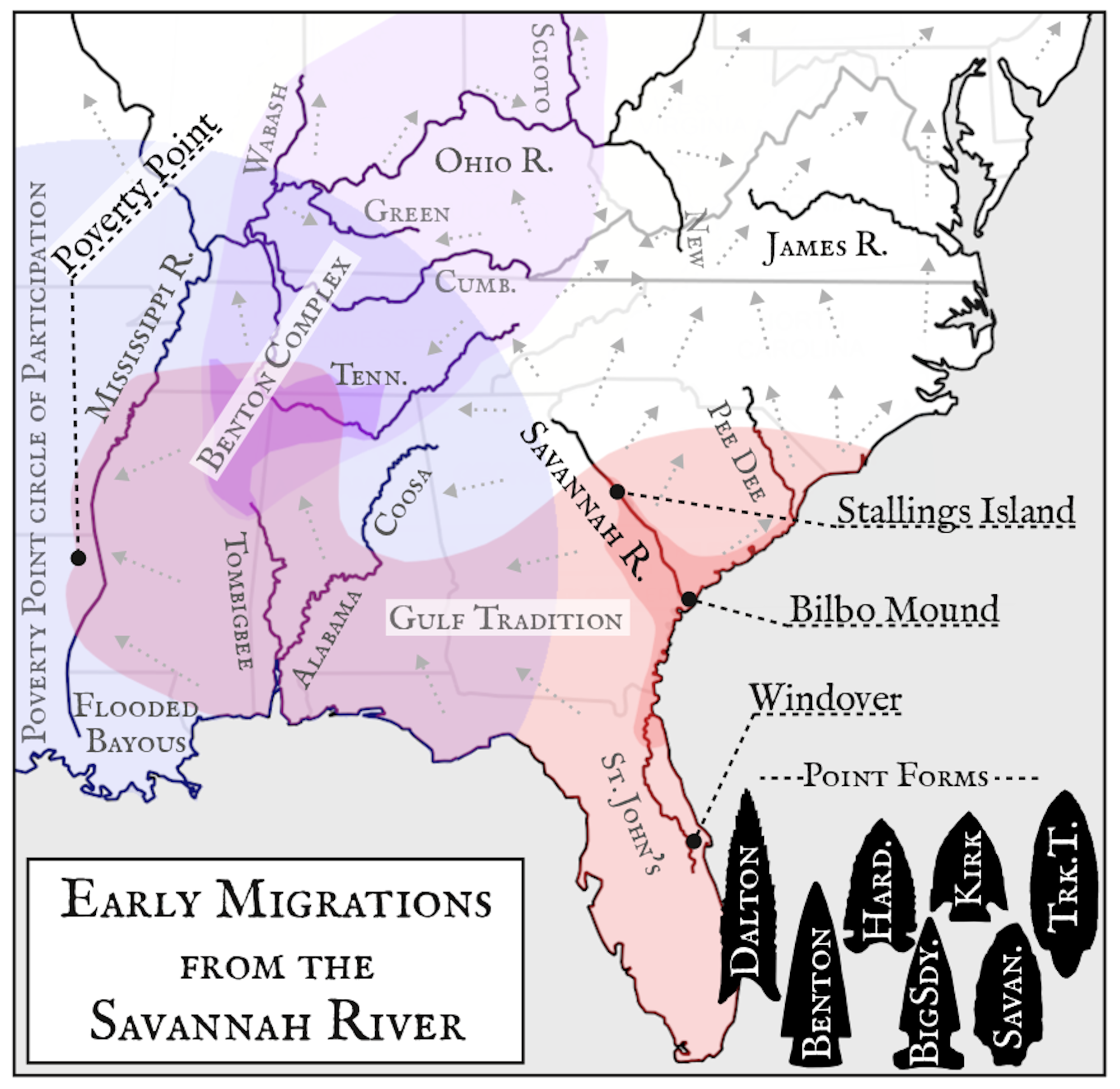
The area shaded in red represents the distribution of material culture associated with artifacts first manufactured in the Savannah Valley. The blue area along the Mississippi River represents the distribution of separate Gulf people who became ancestral to the Poverty Point Complex. The frontiers of these different peoples overlapped (purple areas) and out of these interactions emerged the Benton Complex, which in turn projected farther frontiers toward the copper-mining activity on the Great Lakes and so gave rise to the formative Adena mound-building complex in the Ohio Valley. Map by Brian Bray, from Frontiers of the Lower James River, Part One (2026) and shared via a Creative Commons license.
Within a couple of centuries or so, these people were well-established on the lower Savannah River and began to expand outward into adjacent regions to the north, south, and west, including up along the Blue Ridge and Piedmont of the Carolinas and into Virginia. There these people brought the earliest cookware, clay pottery, Savannah River stone points, and other technologies to both Virginia and the New River Valley. In Southwest Virginia these migrants are associated with the pottery traditions of the New River, Radford, Wythe, Dan River, and related traditions or complexes. Archaeology reveals that these early people developed continuously with little or no cultural breaks until as the 1700s. Historical records from those colonial times demonstrate by linguistics that these tribes were Siouan-speakers, and therefore their Savannah River migrant ancestors must have spoken some form of Proto-Eastern Siouan, as many researchers have suggested and as argued across chapters 2 through 4 of Frontiers of the Lower James River (Greater Barrington Press, 2026). Early Savannah River migrants also occupied the Tennessee, Mississippi, and Ohio valleys, and appear to have been a key component of the formative, copper-trading Adena societies of the Ohio Valley, discussed next.
(Continued in Old Copper Frontiers.)
The Savannah River people and their frontiers are described in much greater detail in chapter 2 of Frontiers of the Lower James River by Brian Bray (Greater Barrington, 2026), available for free online.
|