 Powhatan Tribes in Early Virginia HistoryPowhatan: The ceremonial title of the paramount chief and patriarch of the Pamunkey tribe, hypothesized to have originally meant the leader of a great pow-wow macro-band gathering ceremony, according to the reconstruction of ___________.1The Powhatan Chiefdom (sometimes erroneously called a "confederacy") was complex chiefdom consisting of roughly one hundred and _____ villages, governed by ____ petty chiefs (werowances) belonging to approximately thirty-two distinct, named tribes. The beginnings of the chiefdom were first established some time between the 1560s and 1580s, when the unnamed patriarch of the family and chief of the Pamunkey tribe first came to the Falls of the James River with his son Wahunsenacah, who was ruling as powhatan by the time Jamestown's founding fleet arrived in 1607. The Mattaponi tribe seems to have come with the Pamunkey, and Wahunsenacah inherited eight tribes upon the death of his father. From there he subjugated about three times as many additional Algonquian neighbors through a combination of raids, political decapitations (as with the Kecoughtan tribe), and intermarriages. The First Anglo-Powhatan War (1610-1614) resulted in the loss of some of the Powhatan Chiefdom's most important villages on the lower James, including the key village of Kecoughtan (present-day Hampton), Paspahegh by the mouth of the Chickahominy, and Appomattoc by the mouth of the Appomattox River. The Second Anglo-Powhatan War (1622-1632) dragged on far longer than it had to simply because the colonists began using it as a pretext to seize more land both to revenge the 1622 massacre and to profit the growing planter class, resulting in the loss of Chiskiack on the York River (now Yorktown) and other villages. The Third Anglo-Powhatan War (1644-1646) saw the final dissolution of the Powhatan Chiefdom as a political entity, with its tribes devolving to individual diplomatic relations with the government at Jamestown. 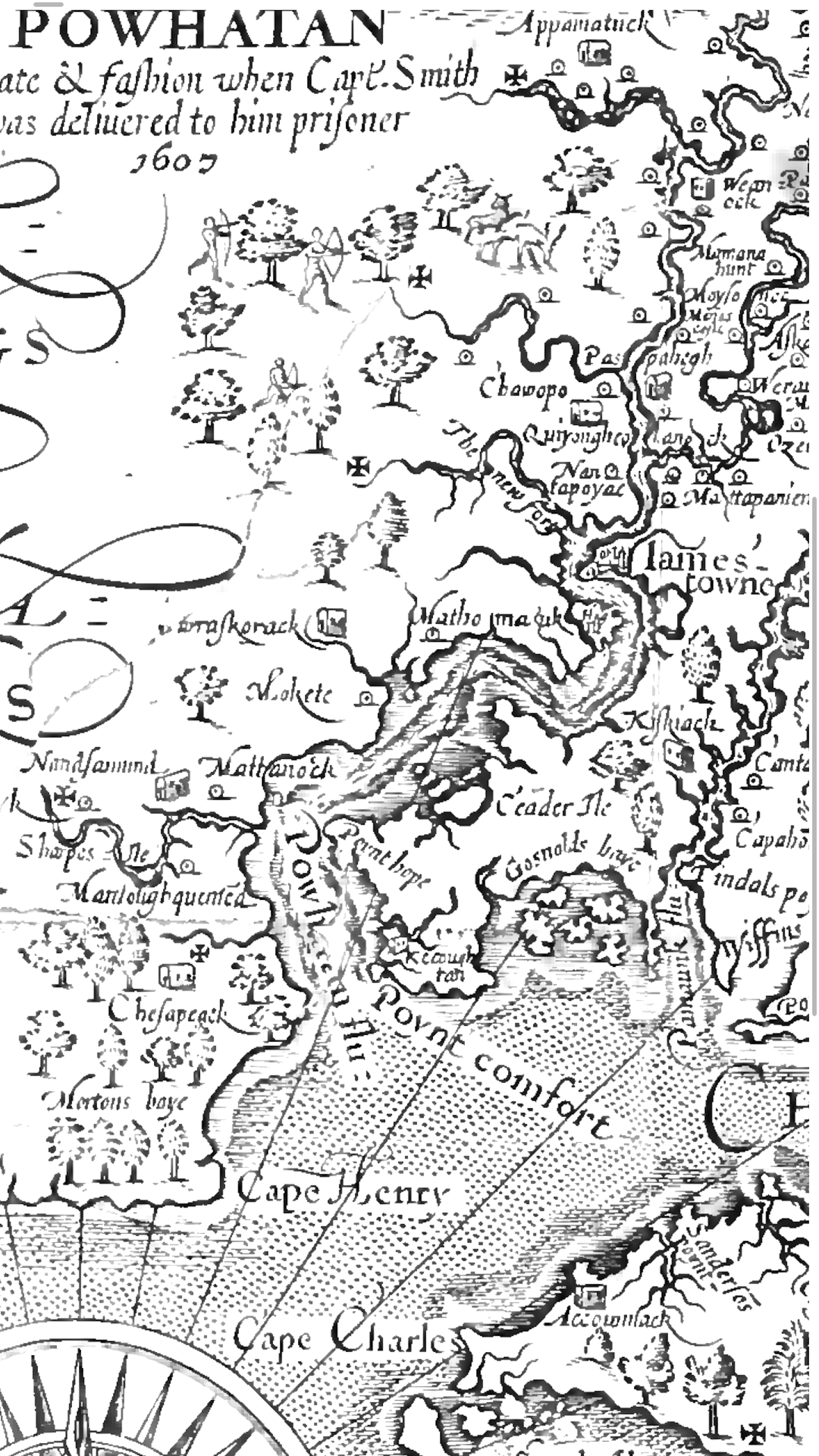 A cropped section of Captain John Smith's Map of Virginia (1612), showing the lower James River. (North is oriented toward the right.) Adapted from chapter 6 of Frontiers of the Lower James River, Part One: Ice Age to 1606, by Brian Bray (Greater Barrington, 2026). Notes |