 Shawnee Tribe and the New River ValleyS(h)aawanwa/S(h)aawano: 'Southerner' in Algonquian.1The Shawnee (plural Shawanoke or Shawanoki in their own dialect2) were an Algonquian-speaking tribe who occupied territory including Virginia's western mountains, New, and Kanawha river valleys down to the Ohio as late as about a generation after the Revolutionary era. Most Algonquian tribes in Virginia and other Atlantic states lived on the coastal plains and spoke an Eastern Algonquian language, but the Shawnee appear to have migrated from the west relatively late in prehistory and so spoke a divergent, Western or Central Algonquian language rather than conforming to the Eastern continuum. They were also among the southernmost Algonquian tribes. The name "Shawnee" is not only Algonquian for "Southerner," but appears to be etymologically related to the name of the Savannah River on the present-day South Carolina-Georgia border, where the Shawnee also resided during the colonial era. Modern archaeologists have traditionally refrained from associating prehistoric archaeological complexes with the ancestors of historic Native American tribes as a matter of methodological policy, but an already-extensive and growing body of evidence indicates that the prehistoric Hopewell mound-building people were the dominant ancestral group (via the intermediary generations of the "Fort Ancient" phase) of the protohistoric and early historic Shawnee and other tribes. 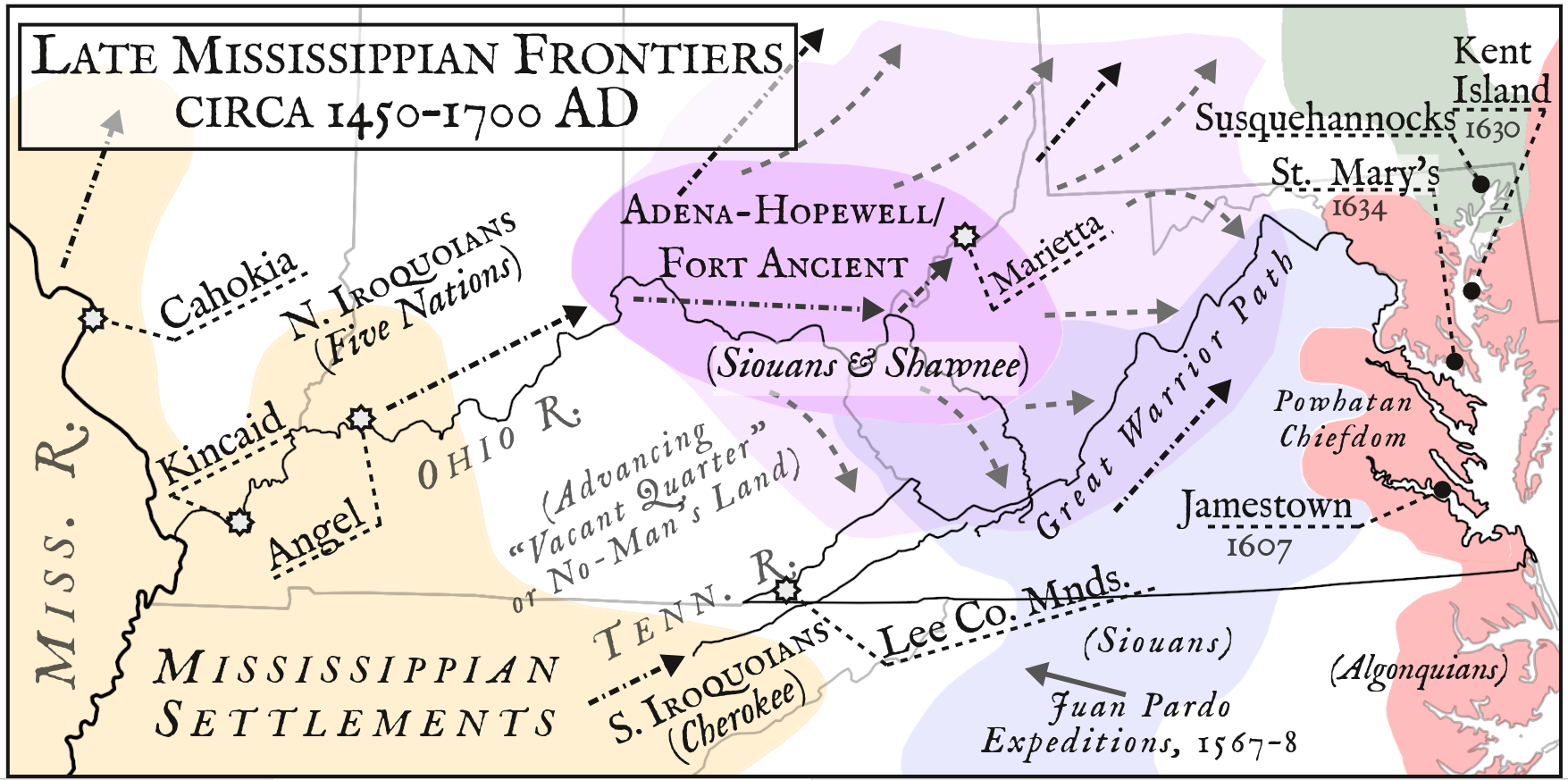 A map depicting late prehistory and protohistoric migrations ongoing into the Spanish and English colonial eras, including the Mississippian migration routes which appear to have resulted in the dispersal of both Siouan-speaking tribes and the Western Algonquian-speaking Shawnee from the Ohio, the two nations which evidently made up the multi-component "Adena-Hopewell" culture during earlier centuries. Once the Mississippians began campaigning up the Ohio River from the Angel Chiefdom in what is now Indiana, the Adena-Hopewell communities left their fertile valleys and fled to the hilltops where they put their mound-building skills to building defensives fortifications. Many of that nation seem to have made their final stands in those hilltop forts, while others escaped into neighboring regions such as Southwest Virginia and the Carolina mountains and piedmont, where they encountered Siouan-speaking cousins in the Southeast and more hostile Cherokee frontiersmen coming up the Tennessee Valley from the west. This map was created by Brian Bray and presented along with accompanying research in Frontiers of the Lower James River, Part One (2026), released via Creative Commons license. The Shawnee nation's early "shatter pattern" distribution suggests invasion, warfare, or some other dispersal and cultural replacement in former homelands. Both archaeological and linguistic evidence of these late prehistoric migrations exist, but it is the synthesis of the two fields of study with early historical records which produces the clearest picture of the dynamic relationships still ongoing when the earliest documentation was made. In short, prehistoric "Mississippian" cultural complexes (including ancestors of both Muskhogean-speakers and more frontier-oriented Iroquoian-speakers) began migrating up the Ohio and Tennessee rivers and displacing tribes already living in those regions, including the ancestors of the Shawnee in Ohio. As argued at greater length in the Fort Ancient sub-chapter of Frontiers of the Lower James River, these ancestors appear to have been the "Hopewell" component of the "Adena-Hopewell" mound-building complex which had been dominant. During the height of the violence the Adena-Hopewell people (already a mixed culture) fled upstream and into the mountains as the "Fort Ancient" complex. Archaeologists consider the "Fort Ancient phase" as the latest prehistoric period in much of the Northeast where the Mississippians and Iroquoian influences never reached. Evidence of Fort Ancient presence has been found widely throughout sites in the New River Valley and adjacent watersheds. Throughout English and British colonial history, the Algonquian-speaking Shawnee were passionate enemies of the Iroquoian-speaking Cherokee, and this rivalry extended deep into prehistory. Despite their feuds with the Cherokee and Northern Iroquoians, the Shawnee (along with lesser-known Siouan tribes related to the Monacans, Saponi, and Tutelo) were the dominant tribes from the New River to the Ohio, and along Virginia's westernmost frontiers during the colonial era. Members of the Shawnee nation were involved in the following historic incidents: Draper's Meadow Massacre, July 30, 1755 Lybrook-Snidow Massacre, August 7, 1774 Dunmore's War, 1774 Battle of Point Pleasant 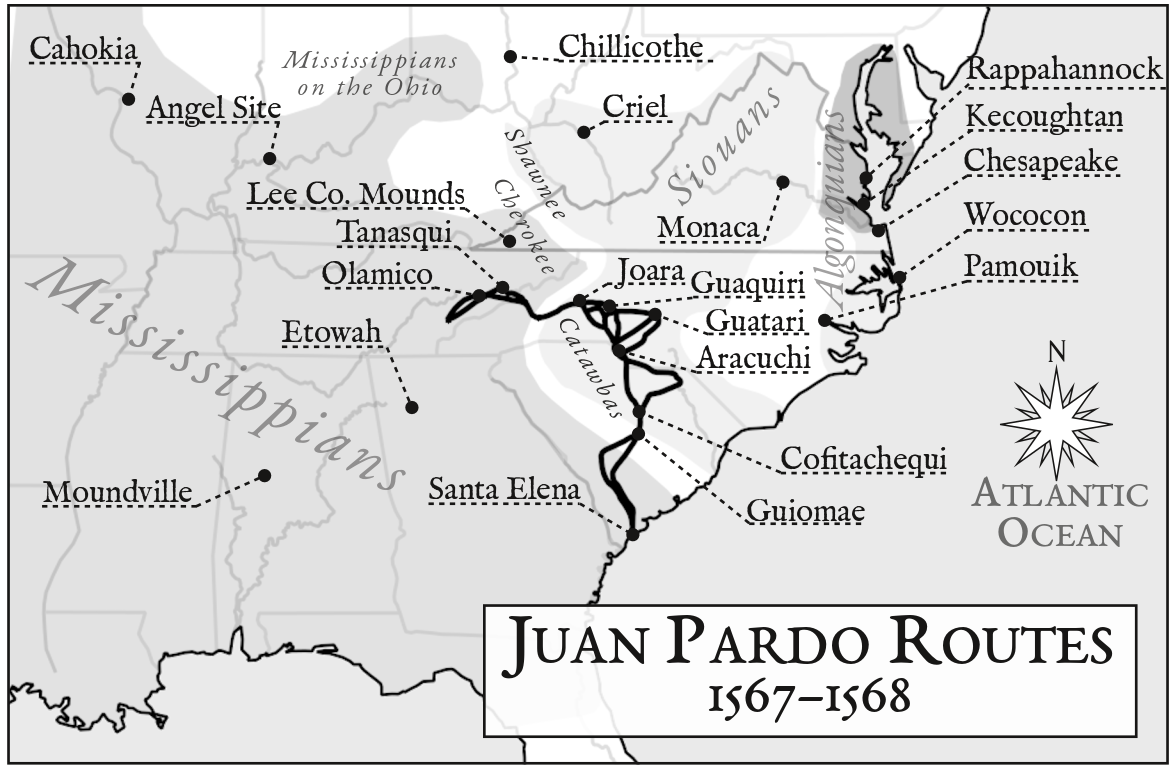 A map of Captain Juan Pardo's routes in 1567 to 1568 as reconstructed by Charles Hudson, with late prehistory or protohistoric native territories and villages added. During this era, the Shawnee still appear to have been warring with the Cherokee and Northern Iroquoian tribes over control of the Ohio Valley (as well as its tributary the Kanawha, downstream of the New). Map by Brian Bray, Frontiers of the Lower James River, Part One (2026), released via Creative Commons license. Notes1. Bruce L. Pearson, "Savannah and Shawnee: End of a Minicontroversy," International Journal of American Linguistics 53, 2 (Apr. 1987), 191.2. Ibid., 188. 3. Ibid., 183-188. |